

Table of Contents
- How Often Should Businesses Schedule Catch Basin Cleaning?
- What Determines Catch Basin Cleaning Frequency for Businesses
- Building a Commercial Catch Basin Maintenance Schedule by Business Type
- Signs of a Clogged Catch Basin You Should Never Ignore
- Your Catch Basin Inspection Checklist for Routine Checks
- Catch Basin Cleaning After Heavy Rain: When to Call for Service
- Conclusion
- Frequently Asked Questions
Last Updated: October 12, 2026
How Often Should Businesses Schedule Catch Basin Cleaning?
Most commercial properties need catch basin cleaning two to four times per year. High-traffic sites with heavy runoff, like restaurant lots and industrial yards, often need it monthly during spring and fall.
Catch basin cleaning frequency for businesses is not a one-size answer. It depends on how much debris your drains collect and how fast water moves through them. At Jonnie On The Spot, we have handled catch basin cleaning across Saginaw and Mid-Michigan for over 40 years. We have seen what happens when property managers wait too long.
A clogged basin does not announce itself. It backs up slowly, then all at once during a storm. By then, you are dealing with flooding, parking lot damage, and unhappy tenants.
So how do you set a real schedule? You start with the factors that drive buildup. Then you match a plan to your property type. Below, we break down every factor and give you a schedule you can use this season.
Twice a year is the floor for most commercial sites. If your lot has trees, food service, or heavy foot traffic, plan on quarterly or monthly service instead.
What Determines Catch Basin Cleaning Frequency for Businesses
Three things drive how often a catch basin needs service: property type, drainage load, and local weather. Change any one of them and your schedule shifts.
A small office lot with two basins is not the same as a restaurant with grease-heavy runoff. Both are commercial. Both need different plans.
Property Type and Drainage Load
Drainage load is the total amount of water, debris, and sediment your system handles. The higher the load, the faster a basin fills.
Here is how load breaks down by property type:
- Restaurants and grocery stores: grease, food waste, and heavy foot traffic push load up fast
- Gas stations and car washes: oil, grit, and soap scum clog quickly
- Industrial and warehouse sites: sediment and gravel from trucks and yards
- Office parks and retail centers: leaves, litter, and light sediment
- Municipal roads and public lots: the heaviest mix of everything
The more load, the shorter the gap between cleanings. A restaurant basin can fill in weeks. An office basin might last a full season.
Local Rainfall and Seasonal Patterns
Mid-Michigan gets all four seasons, and each one changes your drainage picture. Spring snowmelt pushes a wave of water and grit through every basin. Fall drops leaves that mat over grates and block flow.
Summer storms can dump heavy rain in a short window. That surge tests any basin, even a clean one. Winter brings freeze-thaw cycles that crack pavement and send debris into drains.
Track your local rainfall and plan around it. Clean before spring melt and again after leaf drop. Those two windows matter most in our region.
Building a Commercial Catch Basin Maintenance Schedule by Business Type
Use your business type as the starting point, then adjust for trees, traffic, and weather. The table below gives a working baseline for a commercial catch basin maintenance schedule.
| Business Type | Minimum Frequency | High-Risk Season | Watch For |
|---|---|---|---|
| Restaurant / food service | Monthly | Spring and fall | Grease and food waste |
| Gas station / car wash | Monthly | Year-round | Oil, grit, soap scum |
| Retail center / office park | Quarterly | Fall | Leaves and litter |
| Industrial / warehouse | Quarterly | Spring | Sediment and gravel |
| Municipal / public lot | Quarterly to monthly | Spring and fall | Mixed debris, heavy flow |
| Residential complex | Twice a year | Spring and fall | Leaves and light sediment |
This is a starting point, not a fixed rule. A restaurant under oak trees may need service more often. A clean industrial yard with no trees may need less.
The real test is what you find during inspections. If a basin is half full at your last check, shorten the gap. If it is nearly empty, you can stretch it.
Log the debris level at every inspection. After two or three visits, you will see a pattern. That pattern tells you the exact schedule your property needs, better than any generic rule.
Signs of a Clogged Catch Basin You Should Never Ignore
Standing water after a storm is the clearest sign of a clogged catch basin. Other warning signs show up before that, and catching them early saves you a flood.
Watch for these signals:
- Water pooling around a grate long after rain stops
- A slow drain that takes hours to clear
- Foul smells rising from the basin
- Debris or trash visible on top of the grate
- Mosquitoes gathering near standing water in summer
- Cracks or sinking pavement around the basin
- Staining or waterlines on nearby walls
Any one of these means it is time to inspect. Two or more means it is time to call for service.
Do not wait for a backup to act. A basin that overflows can send water into your building, damage your lot, and create a safety hazard. In cold months, standing water freezes into a slip hazard for staff and customers.
Your Catch Basin Inspection Checklist for Routine Checks
A good catch basin inspection checklist turns a vague “looks fine” into a clear record. Inspect each basin on a set schedule, and write down what you find.
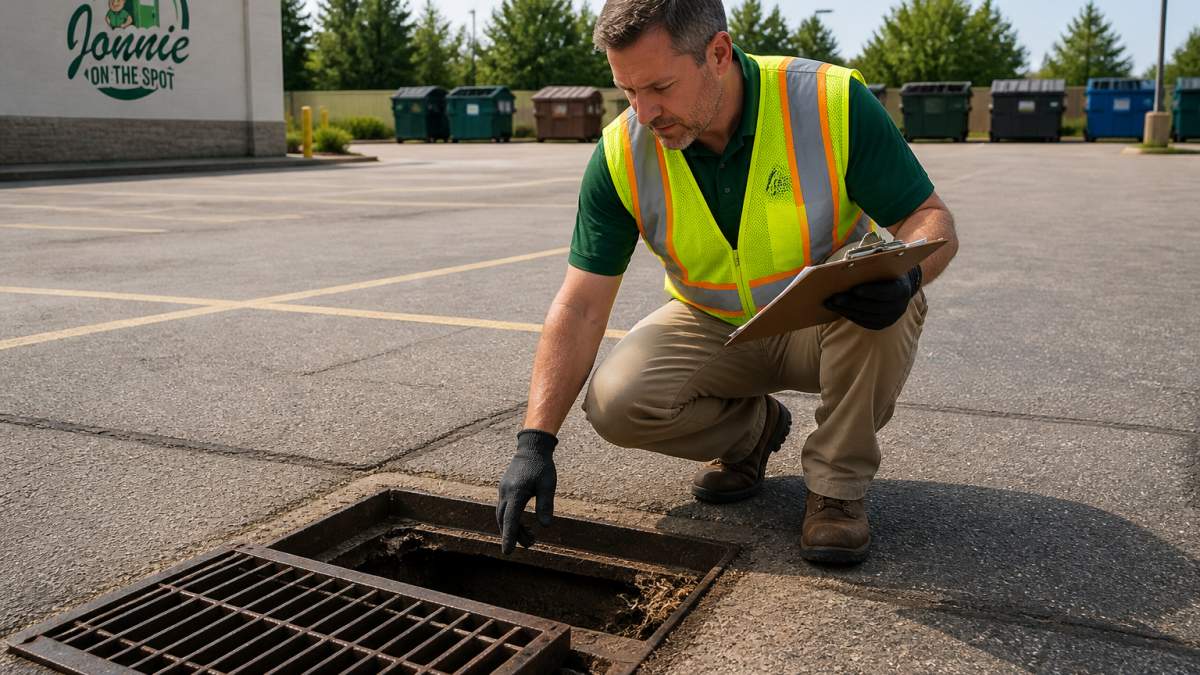
Run through these steps at every basin:
- Check the grate for leaves, trash, and debris blocking flow
- Look for standing water around the basin
- Note the debris level inside the basin
- Check for cracks, settling, or damage to the frame
- Look for oil sheen or grease on the water surface
- Confirm the outlet pipe is not blocked
- Note any odors or pest activity
- Record the date and your initials
What to Record During Each Inspection
Write down four things every time: the date, the debris level, any damage, and the water level. Add a photo if something looks off.
Debris level is the most useful number. Use a simple scale:
- Light: under a quarter full
- Moderate: about half full
- Heavy: over three-quarters full, schedule service now
Over a few visits, this record shows you how fast each basin fills. That is how you set a schedule based on your property, not a guess.
Catch Basin Cleaning After Heavy Rain: When to Call for Service
Call for service after any storm that leaves standing water for more than a few hours. Heavy rain pushes a surge of debris into every basin, and some of it will not clear on its own.
After a big storm, walk your lot and check each basin. If water is still pooling the next day, the basin is likely blocked. Do not wait for the next rain to confirm it.
Here is when to pick up the phone:
- Water sits for more than 24 hours after rain
- A basin looks more than three-quarters full
- You see grease, oil, or a strong odor
- The grate is damaged or the frame is shifting
- Any sign of water reaching a building or walkway
Catch basin cleaning after heavy rain is often the difference between a dry lot and a flooded one. Fast action also protects your pavement, since standing water speeds up cracks and potholes.
Never send a staff member into a basin to clear it by hand. Confined spaces hold dangerous gases and pose a serious safety risk. Call a trained crew with the right equipment.
Conclusion
Keeping your basins clean takes a real schedule, not a reaction after the first flood. Property managers across Saginaw and Mid-Michigan trust Jonnie On The Spot for routine catch basin cleaning, septic service, hydro excavating, and portable restroom needs. With over 40 years of experience, our licensed and insured crew shows up on time and on the spot. We handle multiple sites on one schedule, so you are not juggling vendors. Get a quote from Jonnie On The Spot and keep your property flowing all year.
Frequently Asked Questions
How often should businesses clean catch basins?
Most commercial properties need catch basin cleaning every six to twelve months. Restaurants, gas stations, and lots with heavy traffic or nearby trees often need service every three to six months. Parking lots with light debris can stretch to once a year. Local rainfall matters too: properties in Mid-Michigan should schedule an extra check after spring thaws and heavy summer storms. Treat the schedule as a starting point and adjust it based on what each inspection shows.
How can a business tell if a catch basin is clogged?
Watch for standing water on the pavement hours after rain stops, slow drainage around the grate, a noticeable smell, and debris visible at the grate surface. Mosquito activity near the basin is another clue. If water backs up during even a moderate storm, the basin is likely blocked and needs service soon. Catching these signs of a clogged catch basin early prevents flooding, property damage, and costly emergency calls.
Should catch basins be inspected after heavy rain?
Yes. Heavy rain pushes leaves, sediment, and trash into the basin faster than normal, and it can expose blockages that were not visible before. Walk the property within a day or two of a major storm and check each basin for standing water, debris at the grate, and slow drainage. If several basins are backed up, schedule professional cleaning rather than waiting for the next scheduled visit.
Can a business clean a catch basin itself, or should it hire a professional?
Surface debris like leaves and trash can be removed with a rake or shovel between professional visits. Full cleaning is a different job: it requires lifting heavy grates, working in a confined space, and hauling away sediment and standing water. Professional crews have the vacuum trucks, safety equipment, and disposal methods to do it correctly. Attempting a full clean without that equipment risks injury and can push debris further into the line, making the blockage worse.